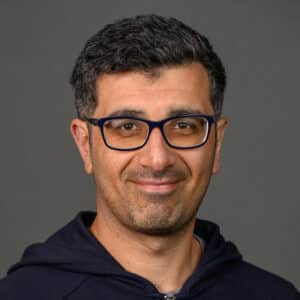
Elchin Jafarov
Senior Research Scientist, Arctic program, Woodwell Climate Research Center (Falmouth, MA)
I study how Arctic permafrost landscapes and their carbon respond to warming and disturbance, and I lead planning for the Arctic Modeling Team at Woodwell Climate Research Center. We use a process-based ecosystem model that represents vegetation dynamics, permafrost and hydrology across the Northern Hemisphere, from the circumpolar Arctic to the boreal regions. Permafrost carbon fluxes are hard to account for and are still poorly represented in global-scale models.
Over the past four years, our team has developed calibration methods, a wetland model, a fire model and data assimilation tools to improve how permafrost carbon is accounted for. We're now building an abrupt-thaw model that adds retrogressive thaw slumps (RTS) and tracks their carbon losses, ground subsidence and vegetation regrowth. In parallel, I'm developing a high-fidelity lake model to study mercury chemistry in Arctic ponds and lakes.
I began my career as an applied mathematician and then moved into geophysics. For my Ph.D. at the University of Alaska Fairbanks I developed a numerical model to predict permafrost warming in Alaska over the coming century. I then worked on permafrost and carbon modeling at the National Snow and Ice Data Center and INSTAAR (University of Colorado Boulder) and at Los Alamos National Laboratory, before joining Woodwell in 2021.
Research interests and methods:
- Permafrost thermal physics and hydrology
- Permafrost carbon feedbacks in land and Earth system models
- Process-based ecosystem modeling (DVM-DOS-TEM)
- Abrupt thaw: retrogressive thaw slumps, subsidence and recovery
- Thermal and biogeochemical modeling of Arctic lakes and ponds, including mercury
- Model calibration, uncertainty quantification and data assimilation
- Model intercomparison (WIEMIP, TVC-HPC MIP)